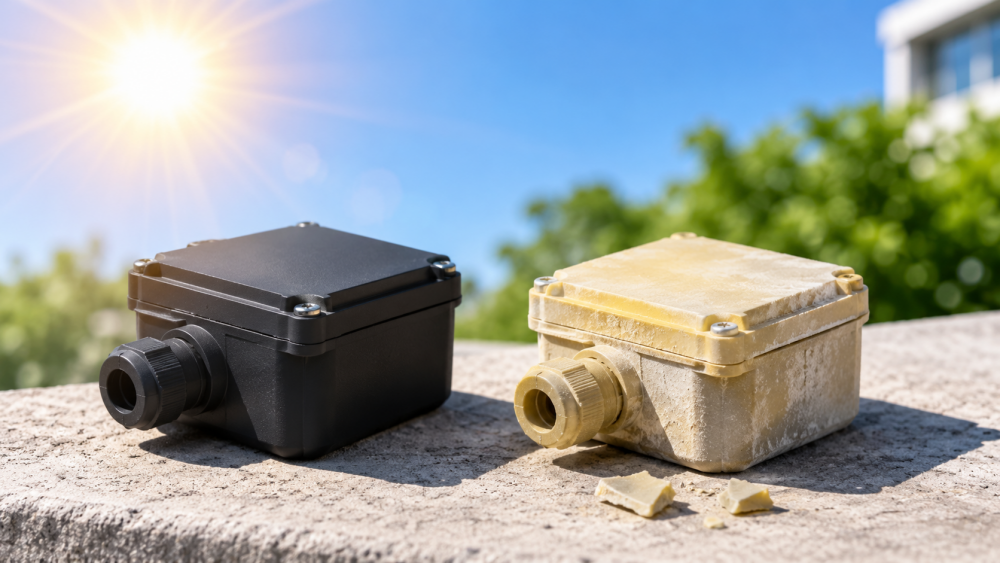
Even when nylon products pass all quality inspections before delivery, their performance may deteriorate after prolonged outdoor exposure. Nylon components used in outdoor lighting fixtures and solar junction boxes, for example, may develop yellowing, surface chalking, and brittleness after just one summer.
This is often caused by insufficient UV resistance rather than an initial material defect. Standard nylon is vulnerable to prolonged UV exposure, especially when combined with high temperatures and moisture.
How Does UV Radiation Damage Nylon?
UV radiation can trigger photo-oxidative reactions in nylon, generating free radicals and causing polymer chain degradation. Over time, this damages the material's molecular structure, resulting in discoloration, reduced toughness, and lower mechanical strength.
According to comparative test data, standard nylon without UV stabilization may retain only 35–45% of its original strength after five years of outdoor exposure, while UV-stabilized nylon may retain approximately 75–90%.
Key takeaway: Yellowing is only the visible sign of aging. The more serious concern is the gradual loss of mechanical strength and toughness.
For outdoor applications, choosing UV-stabilized nylon is essential for maintaining long-term performance and product reliability.
Three Layers of Protection, Each with a Specific Role
Effective weather resistance requires more than adding a single stabilizer. A well-designed formulation combines three complementary approaches: UV shielding, UV absorption, and free-radical scavenging.
01. Physical UV Shielding
For black products, carbon black can effectively block most UV radiation. For light-colored products, where carbon black is unsuitable, surface-treated rutile titanium dioxide can reflect and scatter UV radiation. A typical addition level is 1–2%, helping improve weather resistance while minimizing its impact on mechanical properties.
02. UV Absorbers
UV absorbers target radiation in the 290–400 nm wavelength range. They absorb UV energy and dissipate it as harmless heat, reducing the amount of radiation that reaches and damages the polymer chains.
03. Hindered Amine Light Stabilizers (HALS)
HALS capture free radicals generated during degradation, interrupting oxidation chain reactions. Through a regenerative stabilization cycle, they help maintain long-term material stability.
For nylon applications, selecting a compatible, low-basicity HALS formulation is particularly important to avoid adverse interactions that could reduce stabilizer effectiveness.
Real Weathering Test Results: Measuring Performance Retention
Actual accelerated weathering results provide a more practical way to evaluate material performance. After 2,000 hours of QUV accelerated weathering, UV-stabilized nylon can achieve impact and tensile strength retention rates above 85%, with color difference (ΔE) controlled within 3.2.
Under the same test conditions, conventional impact-modified PA66 may retain only around 50% of its original mechanical properties. This comparison highlights the importance of selecting an appropriate UV stabilization system for outdoor applications.
Where Is Weather-Resistant Nylon Used?
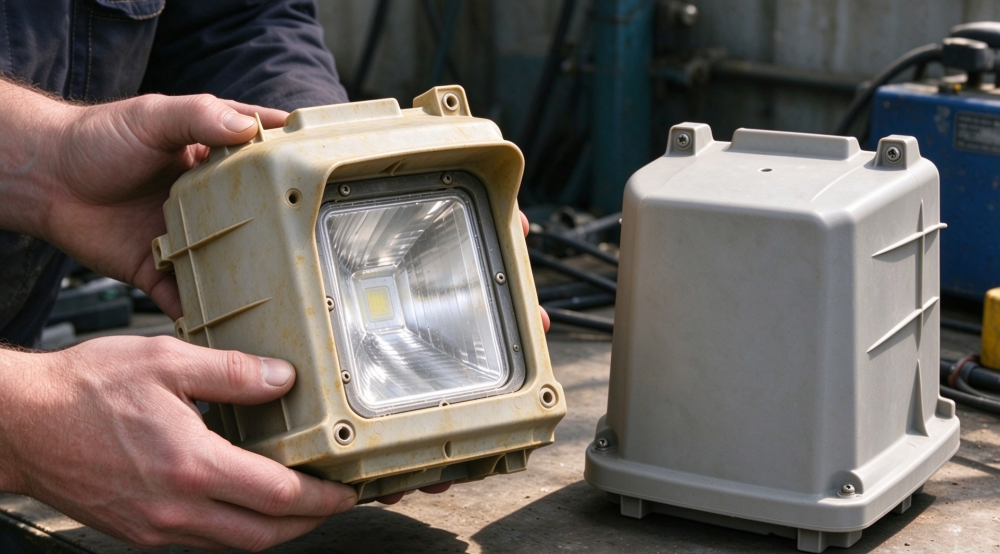
In harsh environments such as deserts with intense UV radiation and coastal areas exposed to salt spray, properly formulated UV-resistant nylon can offer a service life approximately three times longer than conventional nylon, depending on the application and exposure conditions.
For applications where moisture resistance is also essential, long-chain nylon can be considered. Its lower amide group concentration generally reduces moisture absorption and helps improve hydrolysis resistance, making it suitable for demanding outdoor environments.
Typical applications include:
In general, any plastic component expected to remain outdoors for years without regular replacement should have weather resistance included as a key material selection requirement.
Looking for a More Weather-Resistant Nylon Solution?
If your products are experiencing yellowing, embrittlement, or a shorter-than-expected outdoor service life, LFT-G can help you evaluate a suitable weather-resistant material system.
Share your product details, color requirements, and operating environment with our team. We can help assess glass fiber reinforcement, stabilizer formulations, and relevant aging test data to identify a suitable material solution.
Contact LFT-G